
Compact, High‑Reliability Hydrogen Power for Critical Infrastructure
Hydronexus Energy develops power‑dense hydrogen generation systems engineered for data centers, defense, and mission‑critical operations where space, reliability, and logistics matter.
Hydrogen Power, Engineered from First Principles
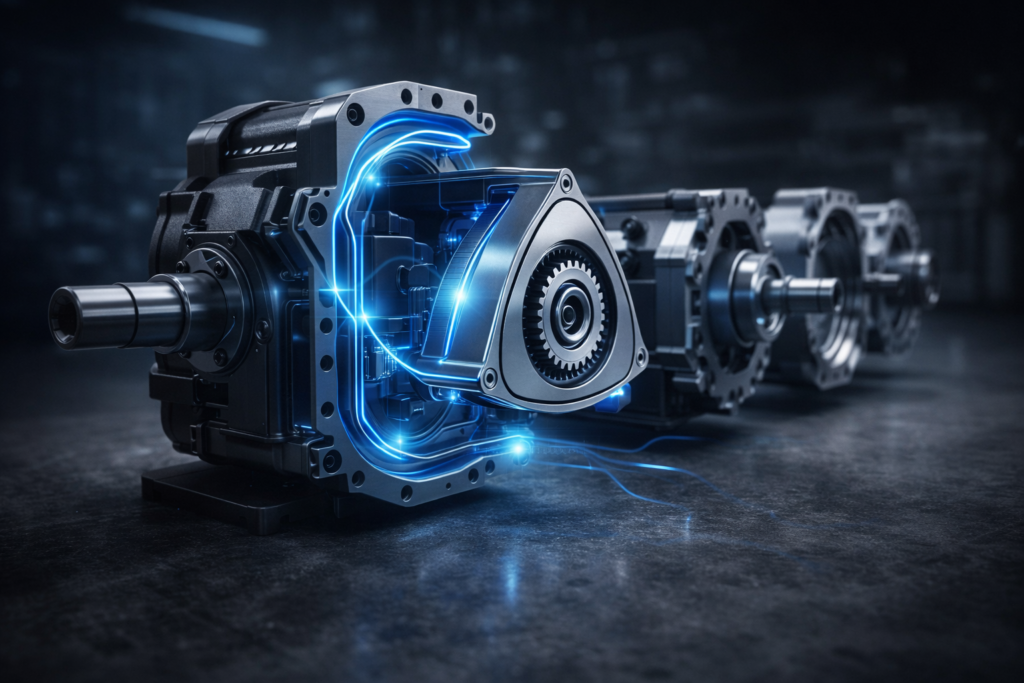
Hydronexus Energy is developing a next-generation hydrogen power platform built around a compact, hydrogen-optimized rotary engine. The system is engineered from the ground up to deliver high power density, continuous-duty reliability, and long-term deployability in space-constrained and mission-critical environments.
Rather than adapting legacy engines to run on hydrogen, our approach begins with the fundamental properties of hydrogen combustion. Architecture, materials, thermal management, and manufacturing methods are all designed specifically to take advantage of hydrogen’s characteristics while addressing its unique engineering challenges. The result is a power system optimized for efficiency, durability, and scalable deployment—without unnecessary complexity.
Why Rotary Architectures Favor Hydrogen
Hydrogen’s combustion characteristics—fast flame speed, wide flammability limits, and clean burn—align naturally with compact rotary architectures. When designed specifically for hydrogen, rotary systems enable continuous combustion cycles with fewer mechanical interruptions than reciprocating engines.
This architecture supports high specific output while maintaining smooth operation and compact packaging, making it well suited for installations where vibration, footprint, and mechanical simplicity are critical constraints.
Key advantages include:
- Packaging flexibility for confined or hardened environments
- Continuous power delivery with reduced cyclic loading
- Fewer moving components compared to piston-based systems
- High power-to-weight and power-to-volume ratios
Thermal Strategy & Continuous-Duty Operation
Thermal management is a primary design driver for hydrogen power systems operating at high load factors. Hydronexus Energy’s approach treats heat not as an afterthought, but as a first-class design constraint addressed through architecture, materials, and system integration.
The rotary platform is engineered to manage sustained thermal loads through controlled heat paths, high-temperature materials, and externalized cooling strategies that avoid unnecessary internal complexity. By separating structural integrity from localized thermal exposure, the system is designed to operate continuously without relying on aggressive internal cooling or consumable-intensive solutions.
This approach enables:
- Stable operation under steady-state, high-duty cycles
- Reduced thermal gradients that drive wear and distortion
- Simplified lubrication strategies compatible with hydrogen combustion
- Improved durability for long-duration, unattended operation
Rather than maximizing short-duration peak output, the thermal strategy prioritizes predictable, repeatable performance over extended operating periods— an essential requirement for critical infrastructure deployments.

Manufacturability & Advanced Materials
Hydronexus Energy’s technology platform is designed with manufacturability as a core requirement, not a downstream optimization. From the earliest design stages, component geometry, material selection, and assembly strategy are evaluated against real-world production constraints and supply-chain considerations.
The system leverages high-temperature alloys and coatings selected for durability under sustained thermal and mechanical loading, while maintaining compatibility with modern manufacturing processes. Advanced additive manufacturing techniques enable complex internal geometries, integrated features, and part consolidation that would be impractical or impossible using conventional methods.
This manufacturing approach supports:
- Reduced part count and simplified assembly
- Improved repeatability and quality control
- Design flexibility without excessive tooling investment
- Scalable production from early units to volume manufacturing
By aligning material science and manufacturing strategy with system-level performance goals, Hydronexus Energy is building a platform that can transition from development to deployment without fundamental redesign—an essential characteristic for long-term infrastructure programs.
Modularity, Redundancy & Deployment
Hydronexus Energy’s power platform is designed to be deployed as modular units that can operate independently or as part of a larger, redundant system. This approach aligns with how critical infrastructure is planned, installed, and operated—prioritizing availability, serviceability, and phased expansion over monolithic solutions.
Individual modules are intended to integrate into standardized enclosures and balance-of-plant configurations, allowing capacity to be added incrementally without redesigning the underlying system. This modular architecture supports common redundancy strategies, including N+1 and distributed generation layouts, while simplifying maintenance and replacement workflows.
From a deployment perspective, the compact form factor enables installation in environments where traditional generation equipment is impractical, including space-constrained facilities, hardened locations, and retrofit scenarios. Systems are designed to support unattended operation, remote monitoring, and predictable service intervals—key requirements for both data center and secure facility applications.
Rather than optimizing for a single installation profile, the platform is engineered to adapt across deployment contexts while maintaining a consistent core architecture. This flexibility reduces integration risk and supports long-term scalability as power requirements evolve.